EPDM Commercial Roofing in the Midwest: Elevate RubberGard for Lake County Buildings
Commercial roofs in Lake County, Kenosha County, and Racine County take a different kind of beating than steep-slope residential roofs. Freeze-thaw cycles, Lake Michigan moisture, summer storms, rooftop equipment, foot traffic, and standing water all test the membrane day after day. For many warehouses, retail centers, offices, schools, and multi-unit buildings, Elevate RubberGard EPDM is worth a serious look. Midwest EPDM commercial roofing projects need a membrane that stays flexible in cold weather, handles UV exposure, and can be detailed cleanly around drains, curbs, penetrations, and edge metal. The right system is not just the sheet itself. It is the insulation, attachment method, flashing, drainage, and maintenance plan working together.
If you manage a commercial flat roof Lake County IL building, the best starting point is not a product brochure. It is a roof assessment that shows what the building actually needs: repair, maintenance, recover, tear-off, drainage correction, or replacement. Lake Point Exteriors helps property managers and facility managers compare commercial roofing systems in Lake County with practical documentation, clear photos, and a system recommendation tied to the roof in front of them.
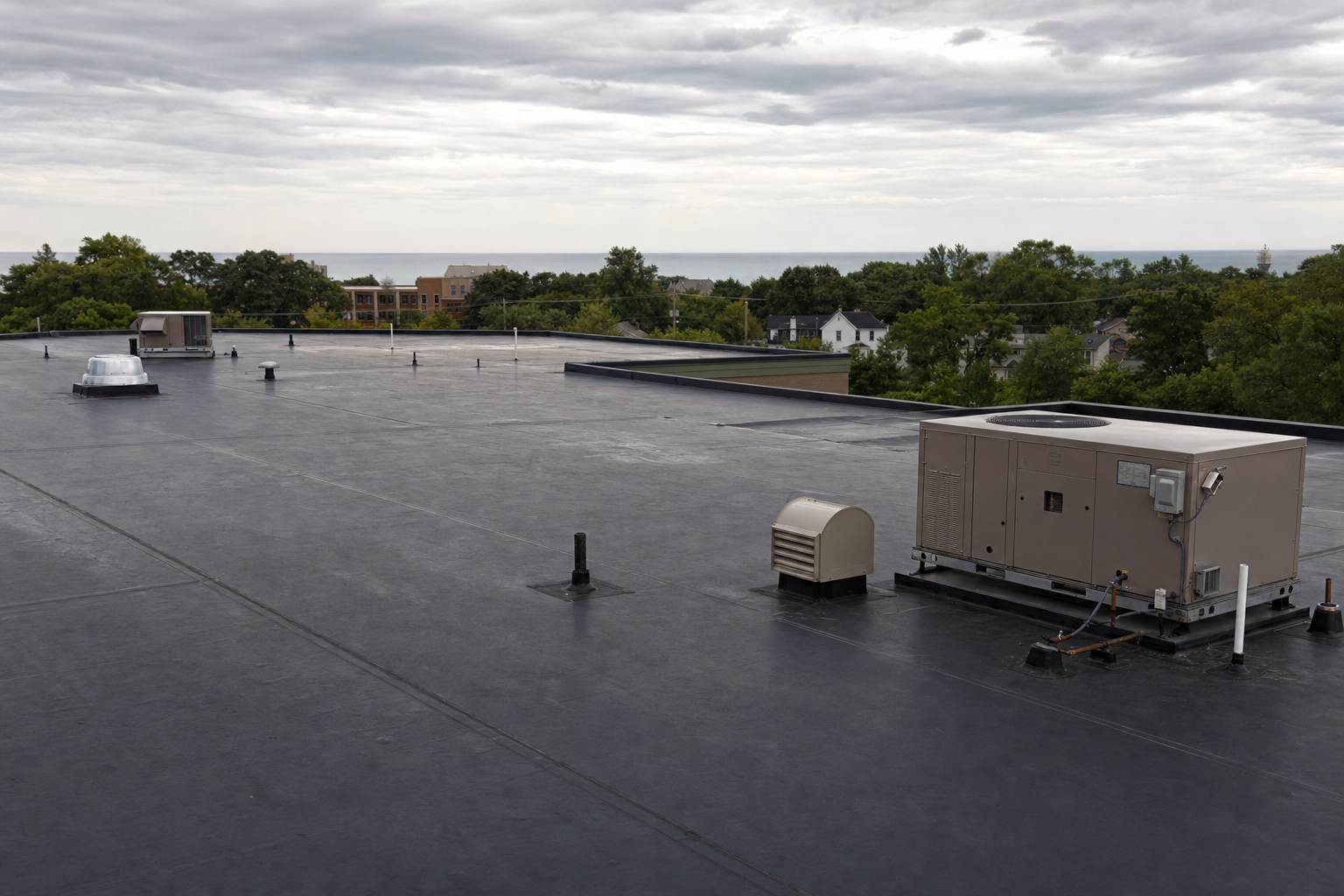
What EPDM Means on a Commercial Roof
EPDM stands for ethylene propylene diene monomer, a synthetic rubber used in single-ply roofing membranes. EPDM roofing membrane is a thermoset synthetic rubber used on low-slope commercial roof assemblies. [1] In plain English: it is a flexible rubber roof sheet designed for low-slope and flat commercial roof assemblies. A low-slope roof is a roof with limited pitch that requires membrane roofing and controlled drainage.
The National Roofing Contractors Association classifies EPDM as a thermoset single-ply membrane, meaning it cures into a stable rubber-like material rather than softening like a thermoplastic membrane under heat. [2]
Elevate RubberGard EPDM, formerly associated with Firestone Building Products, is one of the best-known EPDM product lines in commercial roofing. [3] It is commonly used on low-slope roofs because it can be installed in large sheets, detailed around rooftop equipment, and repaired with compatible accessories when maintained properly. [4]
For Midwest buildings, that flexibility matters. A roof over a Libertyville office, a Waukegan warehouse, a Pleasant Prairie industrial building, or a Kenosha County retail space can move through hot summer afternoons, cold winter nights, snow loads, and repeated freeze-thaw cycles. A membrane that can expand, contract, and stay watertight at seams and details is a real advantage.
Why RubberGard EPDM Fits Midwest Weather
The Midwest is hard on commercial roofs because the problem is rarely one storm. It is the whole year. For epdm commercial roofing midwest property owners compare, weather flexibility is usually the first decision point.
EPDM can be a strong fit when a building owner needs:
- Cold-weather flexibility for winter temperature swings
- A dark membrane that can help absorb heat in colder months
- Proven single-ply performance on low-slope commercial roofing projects
- Fewer field seams when wider sheets are used
- Repairability around punctures, seams, and flashing details
- Compatibility with common commercial roof layouts and rooftop equipment
EPDM is known for weathering resistance, ozone resistance, and low-temperature flexibility when properly formulated. [5] That does not mean every EPDM roof performs the same. Installation quality, drainage, insulation, edge securement, and maintenance determine how well the system performs over time.
Membrane thickness also belongs in the conversation. EPDM roof membrane options commonly include thicknesses such as 60 mil and 90 mil, and the right choice depends on roof traffic, exposure, budget, warranty requirements, and the rest of the assembly. [6] Product choice should follow roof conditions, not brand preference alone.
Where EPDM Works Best on Commercial Flat Roofs
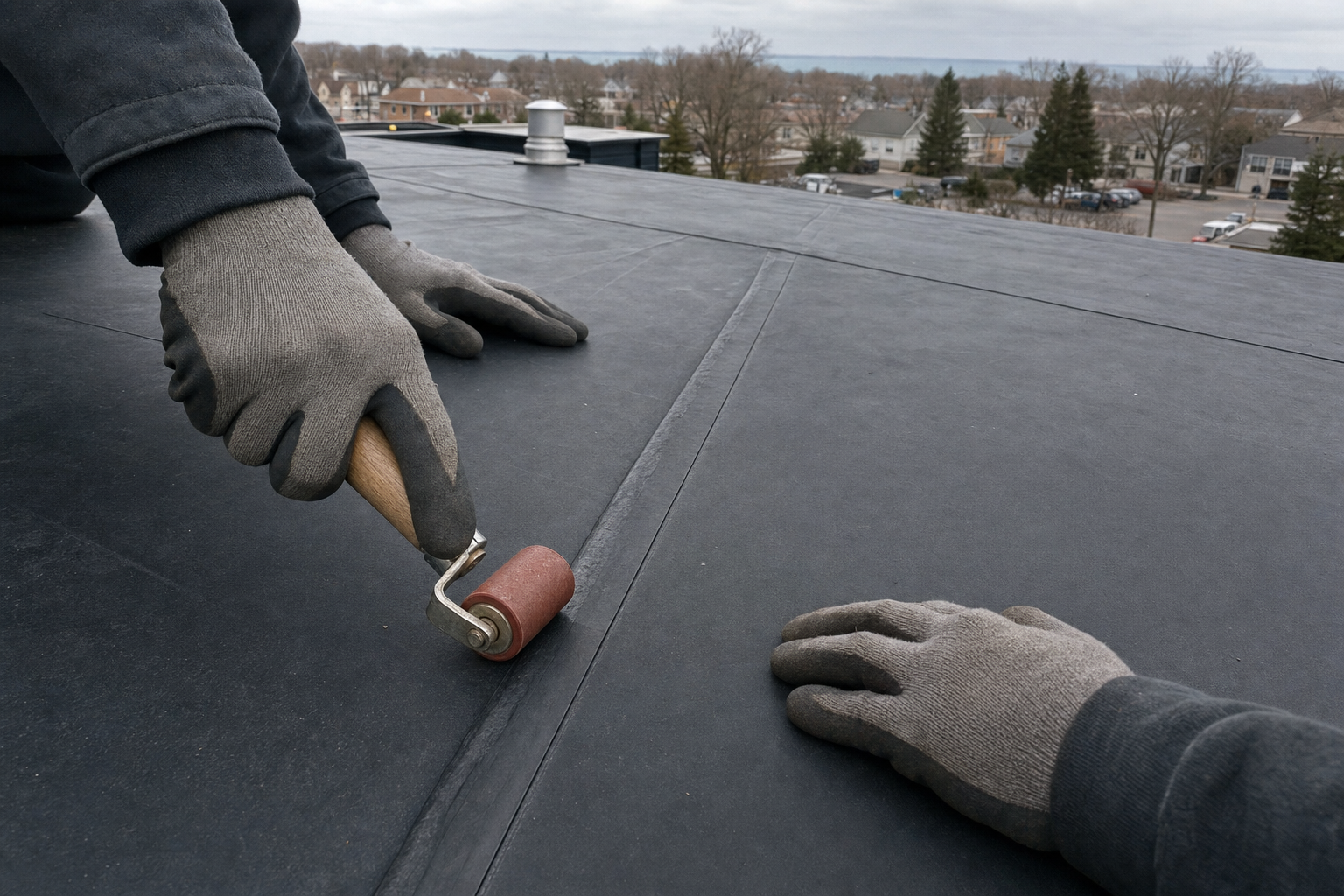
RubberGard EPDM is often a good match for commercial roofs with simple, open roof areas and a lot of rooftop penetrations. Think retail plazas, churches, small industrial buildings, medical offices, apartment buildings, and schools across Waukegan, Gurnee, Zion, North Chicago, Highland Park, Lake Forest, Grayslake, Mundelein, Kenosha, Racine, and nearby approved Wisconsin communities in Kenosha County and Racine County.
It can be installed in different assemblies, including fully adhered, mechanically attached, and ballasted systems. Fully adhered means the membrane is bonded to the substrate with adhesive. Mechanically attached means fasteners secure the roof system to the deck. Ballasted systems use stone or pavers to hold the membrane in place where the building, structure, and manufacturer requirements allow it.
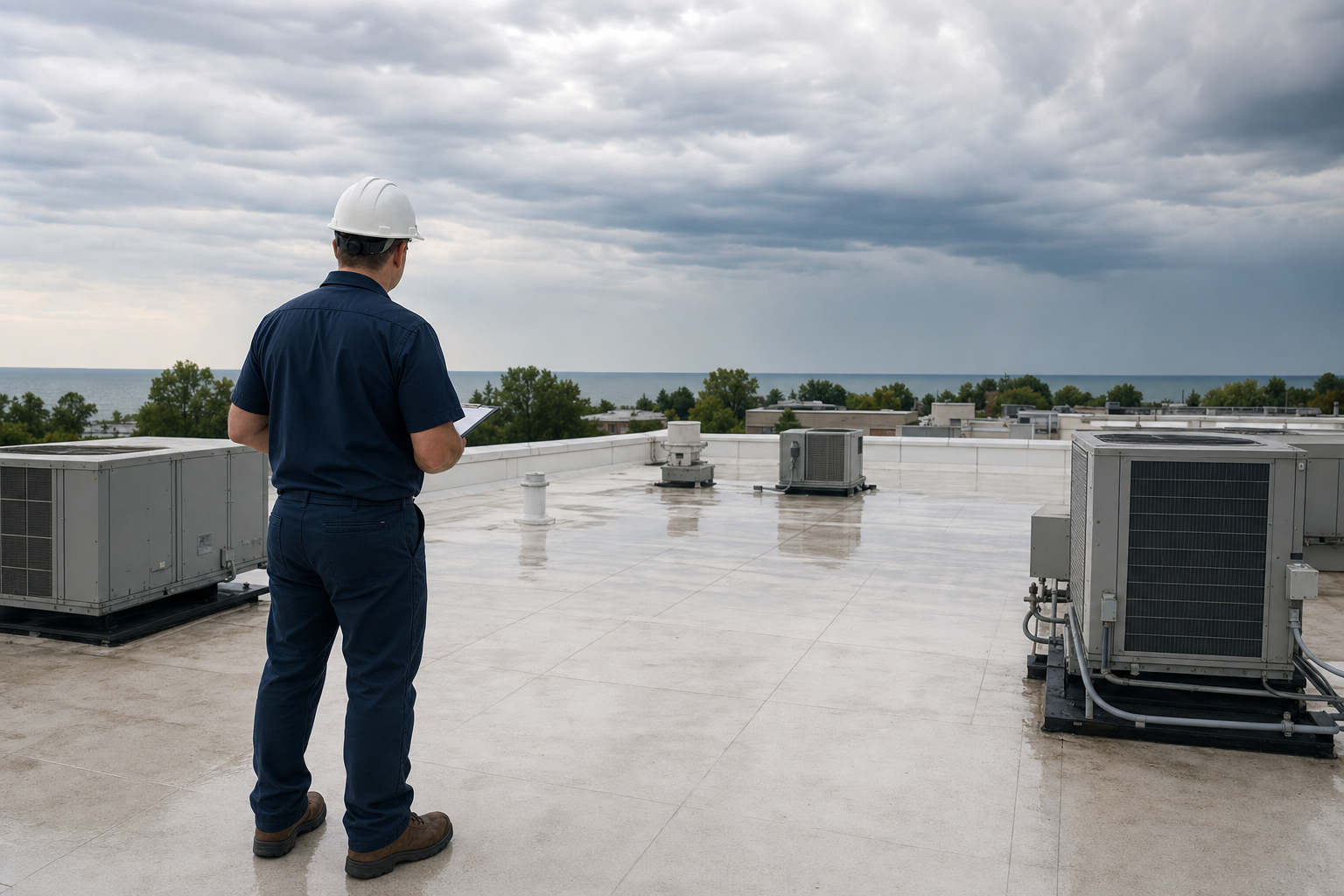
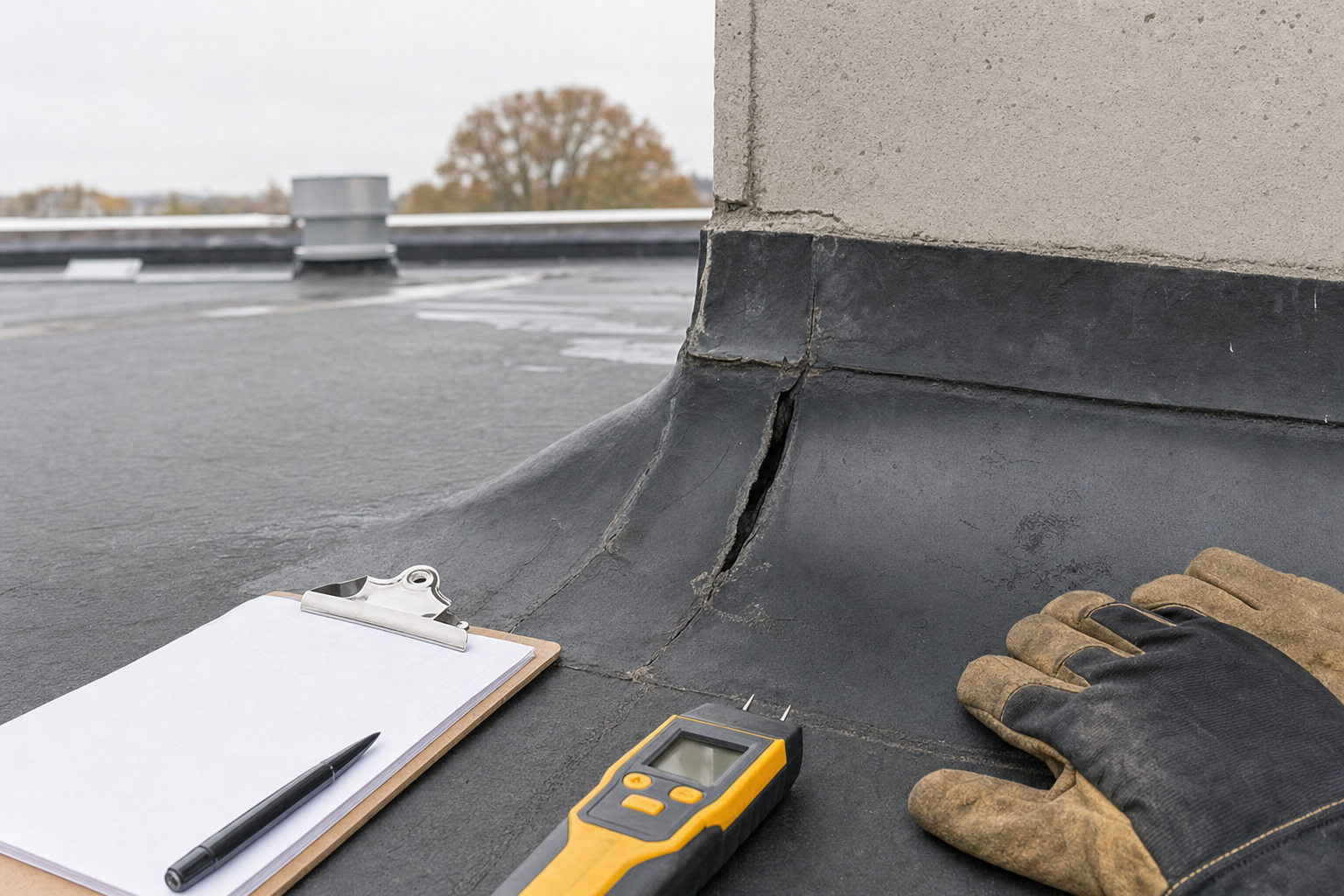
A good commercial roof assessment should document membrane condition, drainage, insulation moisture, flashing, penetrations, and interior leak patterns. That assessment is especially important before a bid or spec is written, because two proposals can look similar on price while solving very different roof problems.
Commercial Roof Inspection Checklist for Lake County Buildings
A good roof assessment should look at:
- Current membrane condition
- Wet insulation or soft spots
- Drainage and ponding areas
- Perimeter edge metal
- Parapet walls and coping
- Rooftop HVAC curbs
- Pipe penetrations and pitch pockets
- Prior repair areas
- Interior leak patterns
- Cover board, insulation, and tapered insulation needs
- Walkway pads for service traffic
- Manufacturer warranty and installer qualification requirements
Ponding water is water that remains on a roof after rainfall because drainage is inadequate. Cover board is a rigid layer above insulation that helps protect the roof system from traffic, impact, and substrate movement. Tapered insulation can help move water toward drains or scuppers when the existing slope is not doing enough.
That interior leak-pattern point is important. Commercial roof leaks can travel through insulation, decking, and structural members before appearing inside the building. A ceiling stain in one spot does not always mean the roof defect is directly above it.
EPDM vs. TPO: The Practical Difference
Building owners often compare EPDM with TPO because both are common single-ply commercial roof systems. The simple version: EPDM is a synthetic rubber membrane, while TPO is a heat-welded thermoplastic membrane.
EPDM may be attractive when flexibility, repairability, and long field performance are priorities. TPO may be attractive when reflectivity and heat-welded seams are priorities. Neither answer is automatic. A shaded medical building in Lake Forest, a wide-open warehouse in Waukegan, and a retail strip in Racine County may each call for a different system.
The better question is: what does the roof need to do for this building?
If the roof has heavy rooftop equipment, frequent service traffic, older drainage issues, or complicated flashing details, the system design matters as much as the product name. Lake Point Exteriors looks at the full assembly so the recommendation fits the roof, not just the brochure.
When to Choose EPDM, TPO, or Modified Bitumen
EPDM, TPO, and modified bitumen solve different commercial roofing problems, so product choice should follow roof conditions rather than brand preference.
| Roof system | Often considered when | Watch closely | | — | — | — | | EPDM | Flexibility, repairability, large open roof areas, cold-weather movement, many low-slope commercial roofing assemblies | Seam detailing, drainage, rooftop traffic, edge securement | | TPO | Reflectivity, heat-welded seams, clean visual inspection, energy goals, white membrane preference | Weld quality, membrane thickness, rooftop traffic, flashing transitions | | Modified bitumen | Multi-layer asphalt-based assemblies, certain tie-ins, durability in specific roof layouts | Weight, heat application method, drainage, compatibility with existing roof conditions |
For an EPDM vs TPO commercial roof decision, the answer should come from the inspection. A commercial roof inspection Lake County property managers can use should show what is failing, what is still serviceable, and what the building needs from the next roof system.
Manufacturer warranties and product literature matter, but they are not a shortcut around installation quality. The contractor should explain what documentation applies, what maintenance is expected, and whether the installer qualifications match the proposed system.
Maintenance Makes the System Last Longer
Even a well-installed EPDM roof needs routine attention. The best time to find a developing problem is before water has soaked insulation or reached inventory, ceiling tile, wiring, or tenant spaces.
For Midwest commercial roofs, schedule inspections around:
- Early spring after snow and ice season
- Late summer after hail and high-wind storms
- Fall before freezing temperatures return
- Any time new rooftop equipment is installed or serviced
The National Weather Service defines severe thunderstorms by hail of 1 inch or larger, wind gusts of 58 mph or greater, or tornado production. [7] After those events, look for punctures, displaced edge metal, clogged drains, lifted flashing, and debris damage. Property managers should also consider storm damage roof inspections after hail or high wind when roof leaks, rooftop equipment damage, or sudden drainage problems appear after a known storm.
IBHS commercial roof guidance emphasizes that regular roof inspection, maintenance, drainage review, and rooftop equipment securement can reduce preventable weather-related damage. [8] Keep photos, dates, inspection notes, invoices, and repair records in the building file so future maintenance decisions are based on a clear roof history. Those records can also support roof damage documentation for insurance claims without turning the contractor into the claim decision-maker.
Schedule a Commercial EPDM Roof Inspection
If you are comparing epdm commercial roofing midwest options for a Lake County, Kenosha County, or Racine County building, start with the condition of the roof you already have. Lake Point Exteriors can inspect your low-slope roof, document what is visible, and explain whether Elevate RubberGard EPDM, TPO, modified bitumen, repair, maintenance, or another system fits the building.
Lake Point Exteriors serves commercial property owners and managers in Lake County, IL, the North Shore, Kenosha County, and Racine County, including Waukegan commercial roofing inspections and roofing service in Kenosha County. Book a free commercial roof inspection and get a clear quote with photos, findings, and practical next steps.
FAQ
Is EPDM a good commercial roofing option for Midwest buildings?
EPDM can be a good fit for Midwest commercial buildings because it remains flexible through temperature swings and works well on many low-slope roof assemblies when drainage, insulation, seams, and flashing are properly designed.
How is EPDM different from TPO on a commercial roof?
EPDM is a synthetic rubber membrane, while TPO is a thermoplastic membrane with heat-welded seams. EPDM is often chosen for flexibility and repairability, while TPO is often chosen for reflectivity and welded seam performance.
What buildings are good candidates for Elevate RubberGard EPDM?
Retail centers, warehouses, churches, schools, offices, medical buildings, and multi-unit properties with low-slope roof areas may be candidates after a roof inspection.
How often should a Midwest EPDM commercial roof be inspected?
Property managers should schedule inspections at least twice a year, commonly after winter and after summer storm season, plus after severe hail, wind, or rooftop equipment work.
Can an EPDM commercial roof be repaired instead of replaced?
Many EPDM roofs can be repaired when the surrounding membrane, seams, flashing, and insulation are still serviceable, but wet insulation, widespread seam failure, or membrane shrinkage may point toward replacement.
References
- National Roofing Contractors Association single-ply roofing membrane guidance ↩
- National Roofing Contractors Association thermoset single-ply membrane classification ↩
- Elevate RubberGard EPDM product information and Firestone Building Products brand history ↩
- Elevate RubberGard EPDM installation and product literature ↩
- EPDM Roofing Association technical guidance on EPDM membrane properties ↩
- Elevate RubberGard EPDM membrane thickness product data ↩
- National Weather Service severe thunderstorm warning criteria ↩
- Insurance Institute for Business & Home Safety commercial roof maintenance and severe weather guidance ↩