Commercial Flat Roof Maintenance in Lake County: Checklist for Local Businesses
For many Lake County businesses, a flat roof only gets attention after a ceiling stain, interior drip, or surprise repair bill. That is risky in local four-season weather, where wind-driven rain, freeze-thaw cycles, summer hail, and Lake Michigan moisture can expose small roof weaknesses fast. Commercial flat roof maintenance Lake County IL property managers can trust is not about panic—it is about a steady schedule, clear documentation, and knowing what to watch for on TPO, modified bitumen/SBS, and other low-slope roofing systems. A consistent commercial flat roof maintenance Lake County IL plan protects inventory, tenants, equipment, and daily operations.
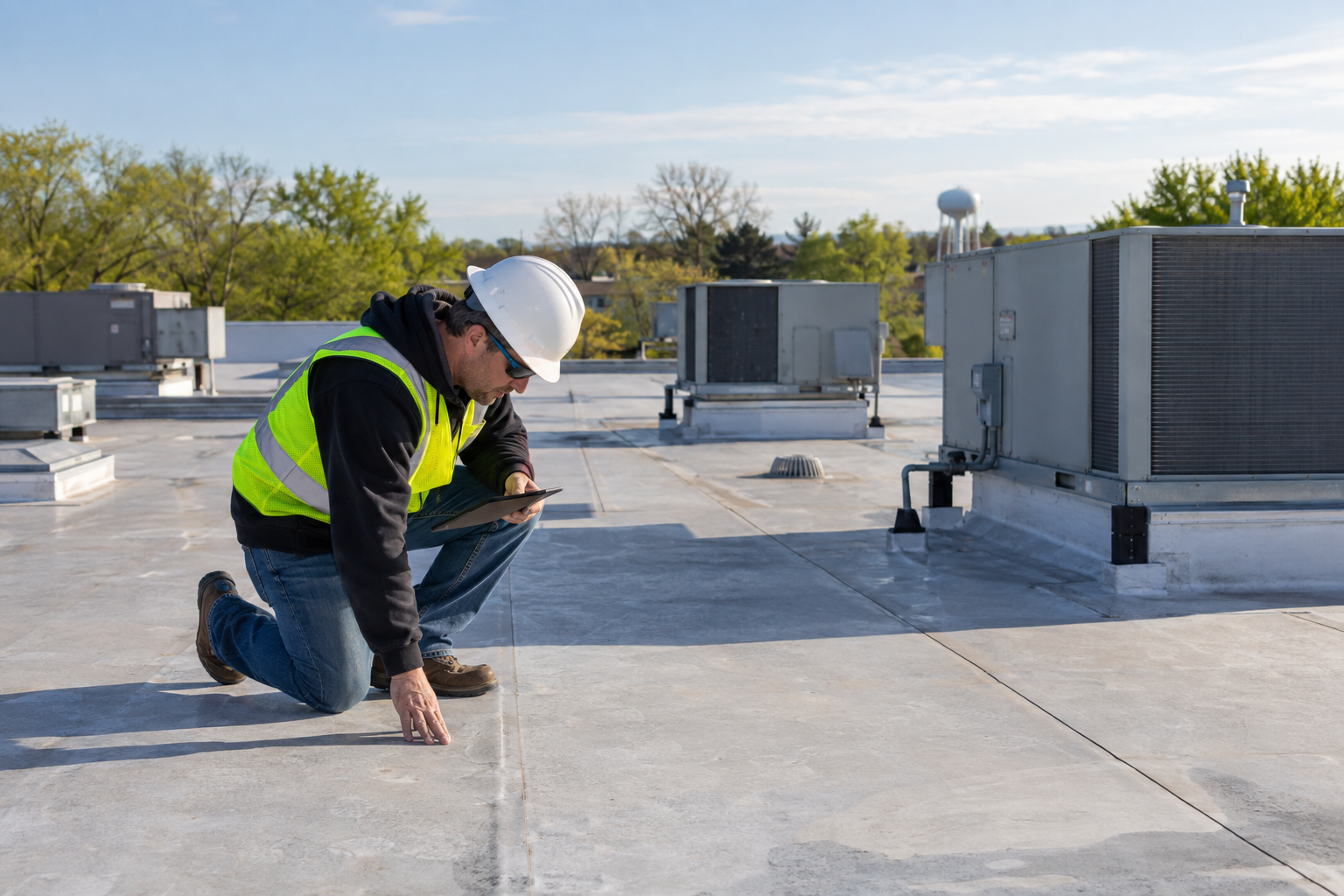
Why Commercial Flat Roof Maintenance Matters in Lake County Weather
Commercial flat roofs are not perfectly flat. They are designed with slight slope so water can move toward drains, scuppers, or gutters. When debris blocks that drainage, water can sit on the membrane, stress seams, and accelerate wear.
In Lake County, Waukegan, Gurnee, Zion, Beach Park, Highland Park, Lake Forest, Libertyville, and Kenosha County and Racine County communities, roofs also deal with four-season movement. Warm afternoons, cold nights, snow, ice, and summer storms all expand and contract roof materials. That movement can affect seams, flashing, penetrations, and rooftop equipment curbs.
The National Roofing Contractors Association recommends routine professional roof inspections at least twice a year, typically in spring and fall, and after major weather events. [1]
For business owners, that schedule helps catch issues while they are still manageable: a loose termination bar, a cracked sealant bead, clogged drain basket, puncture near a service walkway, or seam separation around a rooftop unit.
Spring and fall roof inspections help identify storm damage, winter damage, and drainage problems before they spread. For Lake County commercial roofing, that timing matters because one missed season can turn a small maintenance item into a larger leak source.
Commercial Flat Roof Maintenance Checklist: What Inspectors Should Check
A good maintenance visit is practical and documented. The goal is not to sell you a new roof every time someone walks the building. The goal is to show what is working, what needs attention, and what should be watched.
For property managers comparing commercial flat roof maintenance in Lake County, the inspection should be practical, photo-documented, and specific to the roof system. It should also be completed by trained professionals using appropriate roof access practices and fall protection.
A typical inspection should include:
- Checking roof drains, scuppers, downspouts, and gutter tie-ins for clogs
- Looking for ponding water stains or low areas
- Inspecting seams, laps, flashings, edge metal, and parapet walls
- Reviewing rooftop HVAC curbs, pipe penetrations, vents, and access hatches
- Looking for punctures, membrane shrinkage, blisters, open laps, or exposed reinforcement
- Checking for hail marks, wind-lifted edges, or debris impact
- Photographing conditions so the building owner has a record
Flashing is the material used to seal roof edges, walls, penetrations, and equipment transitions. When it loosens, cracks, or pulls away, water can find a path into the building even if the main roof field still looks serviceable.
Severe hail is defined by the National Weather Service as hail that is one inch in diameter or larger, which is important because hail impact can damage roofing membranes, metal accessories, and drainage components. [2]
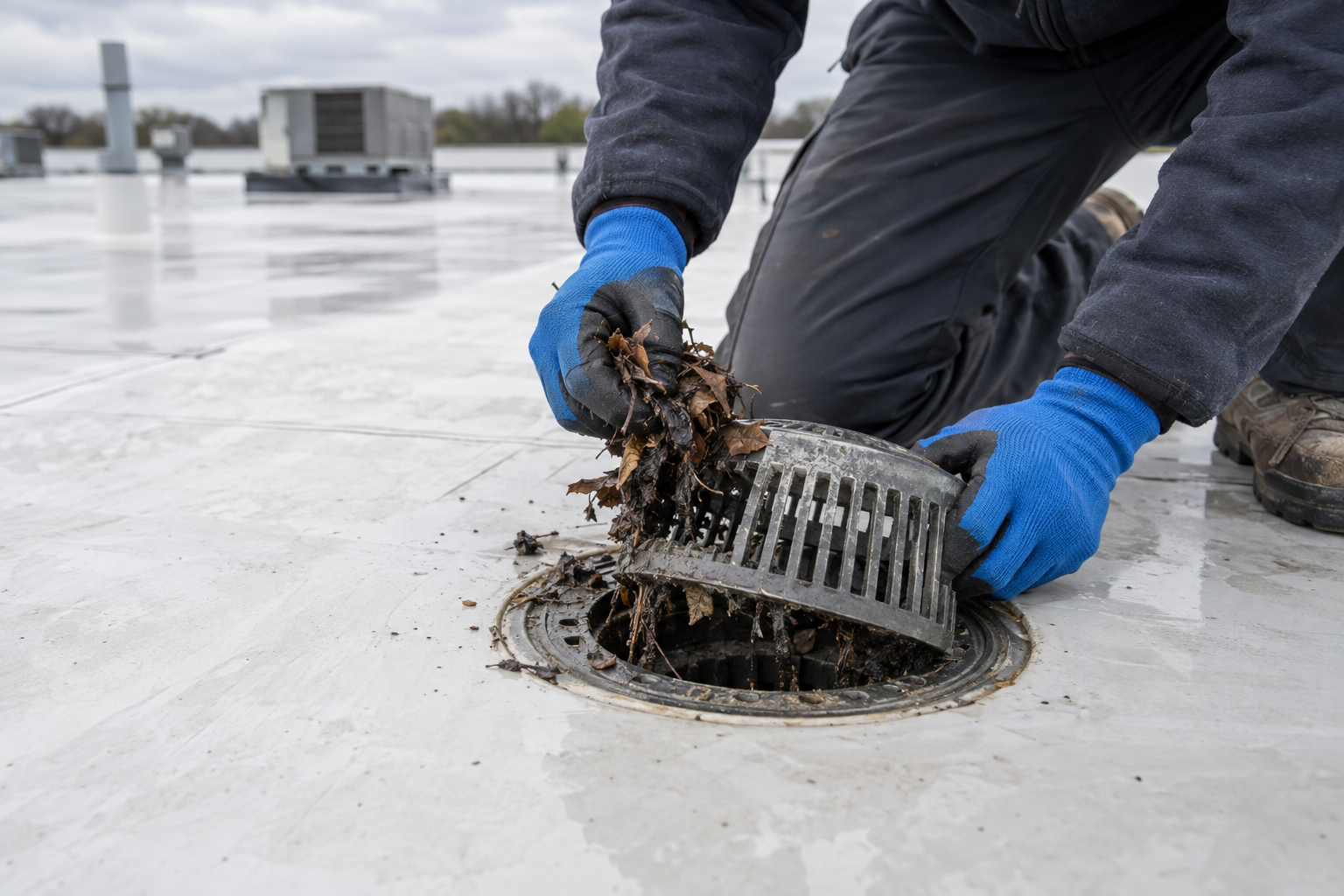
Drainage, Ponding Water, and Roof Leaks
Drainage is one of the biggest flat-roof risk areas. Internal drains, scuppers, gutters, downspouts, strainers, and overflow drainage all need to stay open so water can leave the roof as designed. A scupper is an opening that lets water drain through a parapet wall or roof edge.
Blocked drainage increases the risk of ponding water, seam stress, and interior leaks. Ponding water is water that remains on the roof after rainfall instead of draining properly. If standing water remains after normal drainage time, it should be evaluated because it can point to clogged drains, low spots, insulation compression, structural settling, or slope problems.
For a flat roof inspection Lake County IL businesses can use as a true planning tool, drainage should be documented with photos. That record helps show whether low areas are staying the same, getting worse, or creating repeated leak calls near the same part of the building.
Know Your Roof Type: TPO, EPDM, SBS, and Built-Up Roofing
Different flat roof systems age in different ways. Knowing what is on your building helps you ask better questions during maintenance.
TPO is a white thermoplastic single-ply roofing membrane often used for commercial roofs because of its heat-reflective surface and heat-welded seams. TPO roof maintenance usually focuses on seam condition, punctures, rooftop traffic wear, and flashing details.
EPDM is a synthetic rubber roofing membrane, commonly black, known for flexibility in cold climates. EPDM roof maintenance often includes checking seams, adhesive areas, perimeter edges, and patches from previous repairs.
Modified bitumen/SBS is an asphalt-based system reinforced for flexibility. It may have a granulated surface or coating. Watch for splits, blisters, exposed reinforcement, loose flashing, and wear in drainage areas.
Built-up roofing, also called BUR, is made from multiple layers of asphalt and reinforcement. On older commercial buildings, maintenance may focus on surface cracking, alligatoring, gravel displacement, ponding areas, and flashing transitions.
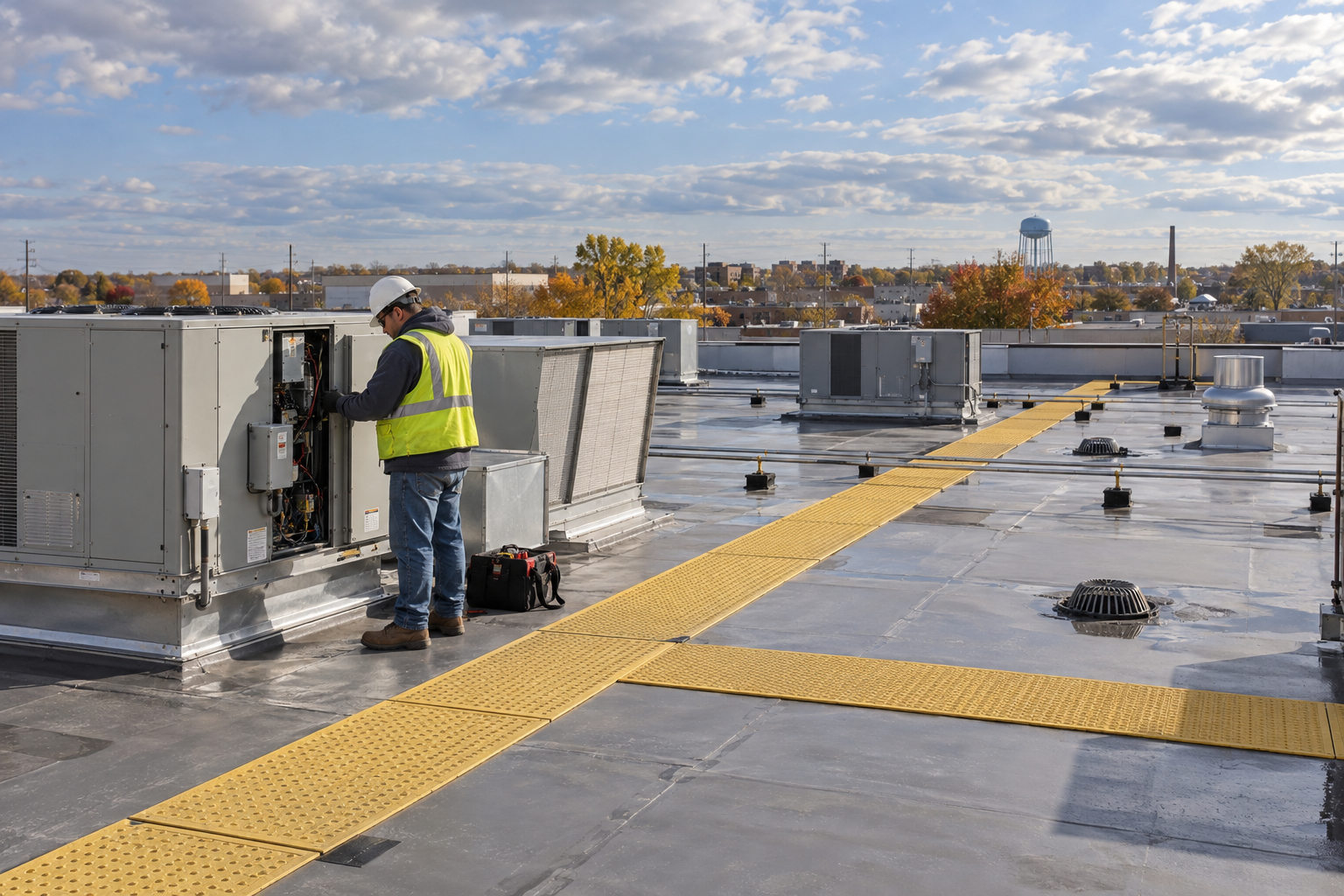
No matter the system, rooftop traffic matters. HVAC technicians, satellite contractors, and maintenance crews can accidentally puncture membranes or leave tools and sharp debris behind. Walk pads and clear service paths help reduce that risk.
Rooftop HVAC service traffic is a common source of punctures, open seams, and flashing damage. During a commercial roof inspection Lake County property managers should ask the inspector to review curb flashing, conduit, gas lines, service walkways, and any areas where trades regularly access equipment.
Seasonal Maintenance Checklist for Lake County Businesses
Flat roof maintenance should match the season. Lake County weather changes fast, and the roof issues you see in March are not always the same ones you see in August.
A strong commercial flat roof maintenance Lake County IL schedule should change with the season, especially before spring storms and winter freeze-thaw cycles.
Spring:
- Check for winter freeze-thaw damage
- Clear debris from drains and scuppers
- Inspect seams, flashings, and edge metal after snow and ice
- Review any ceiling stains that appeared over winter
Summer:
- Watch for hail, wind, and heavy rain damage
- Inspect after strong thunderstorms or derecho-style wind events
- Check rooftop equipment areas after service calls
- Look for membrane bubbling or soft areas
Fall:
- Clear leaves and organic debris
- Confirm drainage is ready before snow season
- Repair open seams or flashing gaps before freezing weather
- Document current roof condition before winter
Winter:
- Monitor interior signs of leaks
- Avoid unnecessary rooftop traffic
- Keep drainage paths in mind during snow and thaw cycles
- Schedule professional evaluation if ice or water backs up near edges
NOAA climate reporting for Illinois tracks severe weather, hail, heavy precipitation, and long-term climate conditions that can affect commercial roof planning across the region. [3]
When Maintenance Turns Into Commercial Roof Repair
Maintenance findings do not always mean replacement. Sometimes the right next step is a targeted repair: resealing a penetration, clearing drainage, repairing a puncture, reinforcing a seam, or addressing loose edge metal before wind and water make the problem worse.
A maintenance issue may become a commercial roof repair recommendation when there is active leaking, open seams, repeated ponding, saturated insulation, storm impact, damaged flashing, or membrane deterioration that cannot be corrected with routine upkeep. If you are comparing options for commercial roof repair in Waukegan and Lake County, ask for photos, a clear scope, and an explanation of whether the repair is meant to stop an immediate leak, extend roof life, or support future replacement planning.
Documented maintenance may also matter for some roof system warranties. Building owners should keep inspection reports, dated photos, repair invoices, and manufacturer information in one file so warranty questions are easier to review later.
If weather damage is suspected, storm damage roof repair should start with a careful exterior inspection and condition documentation before anyone makes assumptions about the scope of work.
Documentation Helps You Make Better Facility Decisions
Every maintenance visit should leave you with more clarity than you had before. Photos, notes, and repair recommendations help you compare roof condition over time.
Good documentation can answer:
- Is the roof aging evenly, or only failing in certain areas?
- Are repeated leaks coming from the same penetration or seam?
- Is ponding water getting worse?
- Are repairs extending roof life, or is replacement planning more realistic?
- Did a storm create new damage patterns?
If weather damage is a concern, documentation can also help you keep accurate records for your property file. Lake Point Exteriors is a licensed contractor, not a public adjuster, so our role is to inspect, document visible exterior conditions, explain repair options, and provide contractor estimates when requested.
For property managers, dated photos and notes are especially helpful after hail, wind, or heavy rain. They create a condition history that can show whether an issue appeared suddenly after a storm or developed over time.
What to Do During an Active Commercial Roof Leak
If water is entering the building, protect people first. Move employees, customers, tenants, inventory, electronics, and equipment away from the affected area when possible. Place containers where water is dripping, but avoid climbing onto the roof or opening ceiling panels if there is any electrical, structural, or safety concern.
Make quick notes before help arrives: where the water appeared, when it started, whether rain or wind was active, and whether rooftop HVAC work happened recently. Photos of interior damage, ceiling stains, and safe exterior views can help the contractor narrow down likely leak sources.
Then schedule a professional evaluation. Lake Point Exteriors can provide commercial roofing services in Lake County, including inspection, documentation, repair recommendations, and maintenance planning for TPO, modified bitumen/SBS, and related low-slope systems.
FAQ: Commercial Flat Roof Maintenance in Lake County, Kenosha County, and Racine County
How often should a commercial flat roof be inspected? Most commercial buildings should be inspected in spring and fall, plus after major hail, wind, or heavy rain events. For commercial flat roof maintenance in Lake County, Kenosha County, and Racine County communities, a spring/fall rhythm plus post-storm checks is the safest baseline.
What is included in commercial flat roof maintenance? Commercial flat roof maintenance usually includes checking drains, seams, flashing, penetrations, rooftop equipment, membrane damage, ponding water, and storm-related wear. A strong visit should also include photos and clear repair recommendations.
What is ponding water? Ponding water is water that remains on the roof after rainfall instead of draining properly. It can point to blocked drains, low spots, insulation compression, structural settling, debris buildup, or slope problems.
Can flat roof maintenance prevent every leak? No. Severe weather, aging materials, installation issues, and rooftop traffic can still cause problems. Maintenance reduces risk by finding weak points early.
Which commercial flat roof systems need maintenance? TPO, EPDM, modified bitumen/SBS, and built-up roofing all need routine maintenance because seams, flashing, drainage, and rooftop traffic can create leak risks.
Does hail damage commercial flat roofs? Yes. Hail can bruise or puncture membranes, dent metal accessories, damage drainage components, and weaken older commercial flat roof systems.
Does Lake Point service commercial flat roof systems? Yes. Lake Point Exteriors works with commercial flat-roof systems including TPO and modified bitumen/SBS across Lake County, IL and nearby Kenosha and Racine County communities.

Closing CTA
If your building is in Waukegan, Gurnee, Zion, Beach Park, Lake Forest, Libertyville, Kenosha County, Racine County, or nearby Lake County communities, Lake Point Exteriors can help you get a clear read on your flat roof. Document concerns, note any active leaks or drainage issues, and book a free commercial roof inspection or quote. We will walk the roof, explain what we see in plain English, and help you plan the next right repair or maintenance step.
Request a free roof inspection from Lake Point Exteriors and get a practical maintenance plan for your commercial flat roof. To schedule a commercial roof inspection, contact the team today.