TPO vs EPDM Commercial Roof: Best Flat-Roof Membrane for Lake County Buildings
Choosing between TPO vs EPDM commercial roof systems can feel simple at first: one is usually white, one is usually black, and both are common on flat or low-slope buildings. But in the Lake Michigan climate, the better choice depends on more than color. This TPO vs EPDM commercial roof decision should start with the building’s use, drainage, insulation, and exposure. Lake County, the North Shore, Kenosha County, and Racine County buildings deal with hot sun, lake-effect moisture, freeze-thaw cycles, heavy rain, wind, snow load, and summer hail risk. For a retail building, warehouse, office, church, or multifamily property, the right membrane should match the building’s insulation, drainage, rooftop traffic, budget, warranty requirements, and maintenance plan.
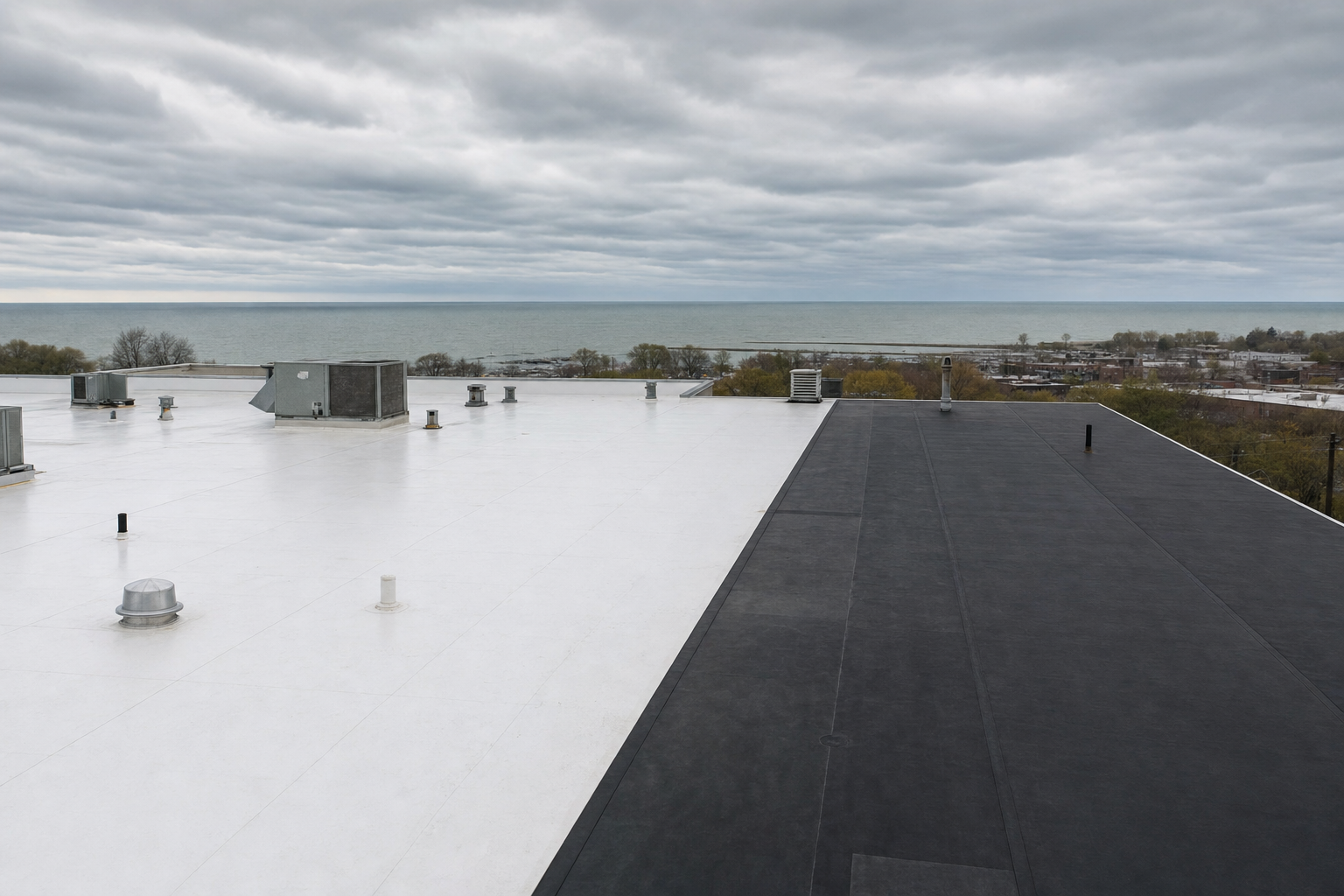
What TPO and EPDM Mean
A single-ply membrane is one layer of factory-made roofing material installed over insulation or another roof substrate. A TPO vs EPDM commercial roof comparison starts with how each membrane is joined and repaired.
TPO stands for thermoplastic polyolefin. It is a single-ply commercial roofing membrane, typically light-colored, that can be heat-welded at the seams. ASTM D6878 covers thermoplastic polyolefin-based sheet roofing, and industry guidance describes TPO as a reinforced thermoplastic membrane capable of heat-welded field seams and repairs. [1]
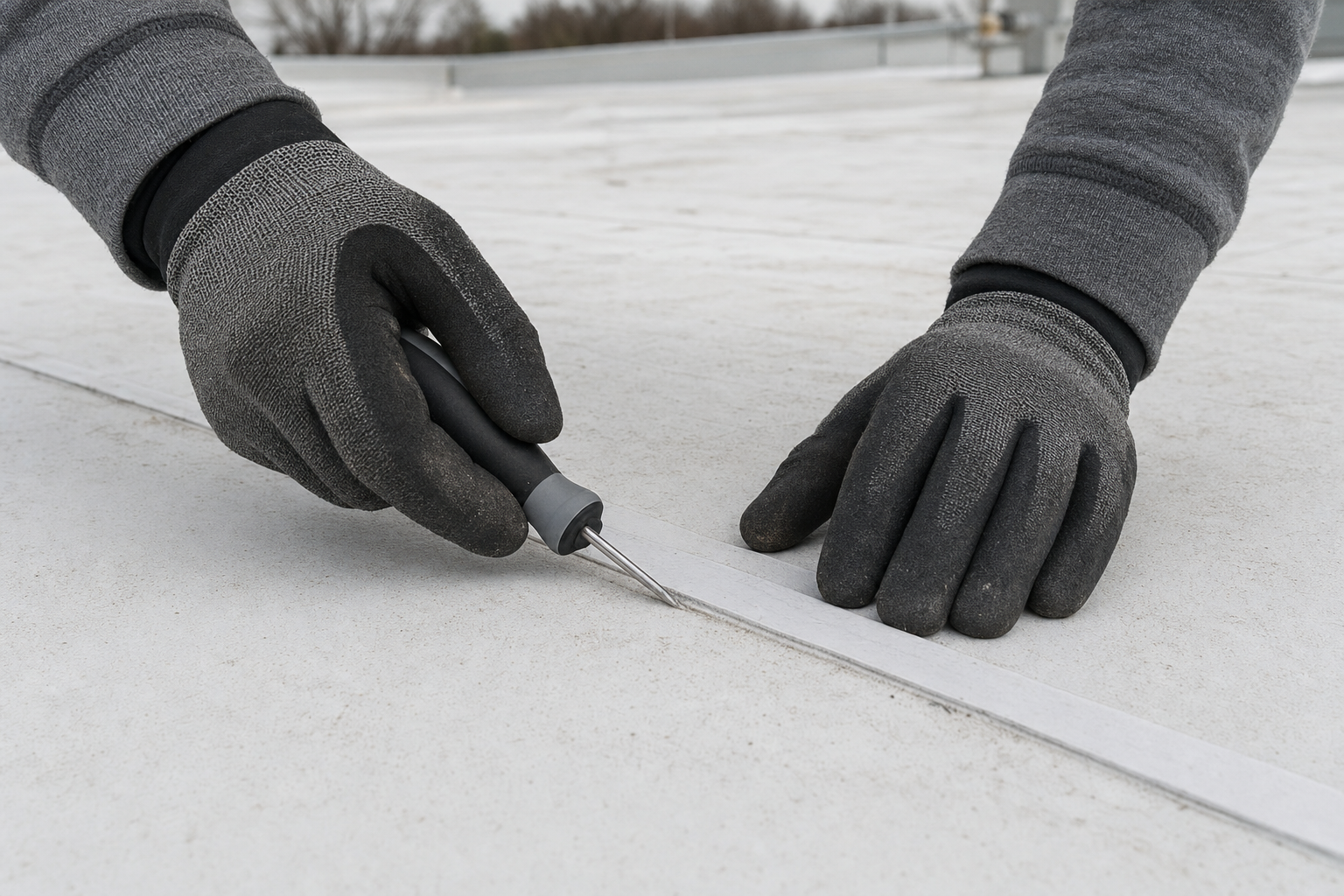
A heat-welded seam is a seam fused with hot air to bond compatible thermoplastic sheets. TPO roofing uses heat-welded seams that can create a continuous membrane bond when installed correctly.
EPDM stands for ethylene propylene diene monomer. It is a synthetic rubber membrane used in single-ply roofing, and roofing practice manuals classify EPDM as a thermoset material, meaning it is bonded with adhesives rather than re-fused with heat after curing. [2]
A thermoset membrane is a cured membrane that cannot be re-melted and is typically joined with adhesives or tape. EPDM roofing is a synthetic rubber membrane valued for flexibility in cold-weather roof assemblies.
In plain English: TPO behaves more like a weldable plastic sheet, while EPDM behaves more like a flexible rubber sheet. Both can work well when designed and installed correctly.
Where TPO Makes Sense in Lake County and Southern Wisconsin
TPO is often chosen for buildings where summer heat gain matters. A white or light reflective roof can reduce the amount of heat transferred into a building, and the EPA defines cool roofs by high solar reflectance and thermal emittance. [3]
That can matter for Lake County retail spaces, offices, restaurants without heavy rooftop grease exposure, and buildings with large open roof areas. TPO’s heat-welded seams are also a major reason property managers like it. When installed correctly, the welded seam becomes a continuous bond instead of relying only on tape or adhesive.
For this TPO vs EPDM commercial roof decision, TPO often wins when cooling load and welded seams matter most. TPO roofing Lake County projects can also be a strong fit when the roof has clean access, a straightforward layout, and a maintenance team that can keep the membrane surface reasonably clean.
TPO may be a strong fit when:
- The building has high cooling demand in summer.
- The owner wants a bright, reflective roof surface.
- The roof has straightforward drainage and clean access.
- The project benefits from heat-welded seams.
- The maintenance team can keep the surface reasonably clean.
The tradeoff is that TPO quality depends heavily on membrane thickness, manufacturer system, welding conditions, warranty requirements, and installer skill. A cheaper TPO roof installed poorly is not a bargain.
Where EPDM Makes Sense in the Lake Michigan Climate
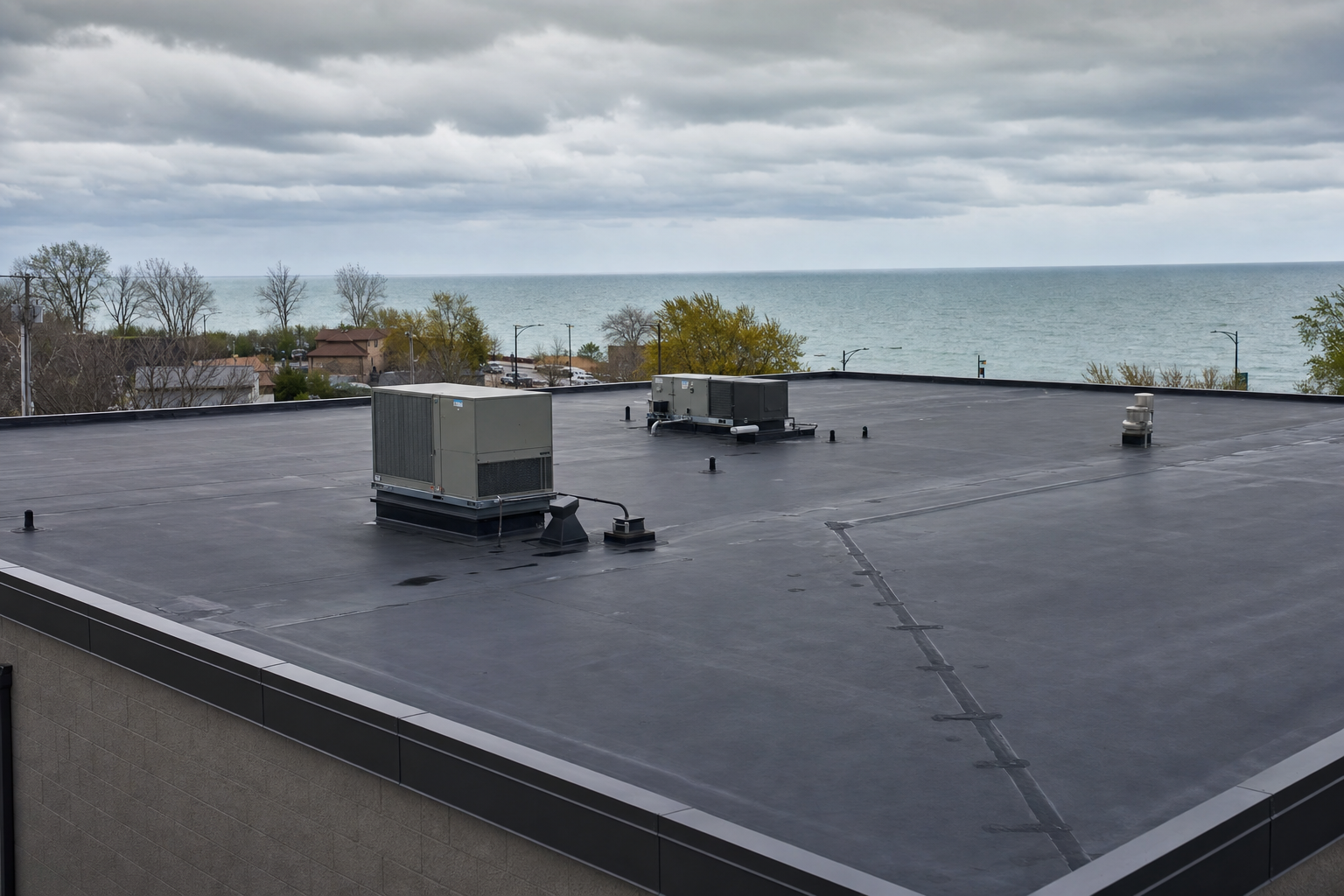
EPDM has a long track record on commercial flat roofs across cold-weather markets. Its biggest strength is flexibility. In a region where roofs expand under August sun, contract during January cold, and see repeated freeze-thaw cycles near Lake Michigan, that flexibility can be valuable.
In a TPO vs EPDM commercial roof comparison, EPDM often makes sense when flexibility and complex details are priorities. EPDM roofing Lake County projects may also make sense on roofs with many penetrations, older details, or budget constraints that still require a proven commercial flat roof membrane.
EPDM can be a practical fit for:
- Large commercial roofs where budget control matters.
- Roofs with many penetrations, curbs, vents, or equipment stands.
- Buildings where winter movement and flexibility are priorities.
- Owners who want a proven rubber membrane with familiar repair methods.
- Roof areas with less concern about a bright reflective appearance.
The main tradeoff is seam style. EPDM seams are typically adhesive- or tape-bonded, so workmanship, surface prep, and maintenance matter. Black EPDM can also absorb more heat than a reflective white membrane, though insulation level and roof assembly design often matter more than membrane color alone.
White EPDM is also available in some systems, so the decision should not be reduced to “TPO is white and EPDM is black.” Membrane color affects surface heat, but insulation and roof assembly design often control building performance more than color alone.
Lake County Weather Factors That Should Drive the Choice
For a commercial flat roof in Waukegan, Gurnee, Zion, Libertyville, Highland Park, Lake Forest, Grayslake, Kenosha County, or Racine County, the membrane is only one part of the decision. Property managers comparing low-slope commercial roofing options should also think about drainage, insulation, penetrations, rooftop service traffic, and storm exposure.
Lake Michigan weather makes the TPO vs EPDM commercial roof choice a full roof-system decision, not only a membrane-color decision. A commercial flat roof membrane should be chosen after drainage, insulation, penetrations, traffic, and maintenance access are reviewed.
Drainage comes first. Standing water is hard on any flat-roof system. Ponding water means water that remains on a low-slope roof after drainage should have occurred. Before choosing TPO or EPDM, the roof should be checked for slope, drains, scuppers, gutters, soft insulation, and low spots.
Insulation matters. A well-insulated roof assembly can reduce the impact of membrane color in both summer and winter. A poorly insulated building may feel the difference more.
Rooftop traffic matters. HVAC service paths, restaurant equipment, satellite equipment, and maintenance crews can create puncture and wear risks. Walk pads and protection details should be part of the plan.
Storm exposure matters. The National Weather Service defines severe thunderstorms as storms with hail at least 1 inch in diameter or wind gusts of at least 58 mph, both of which can affect roof systems and rooftop equipment. [4]
Repairability matters after storms, too. Small punctures, opened seams, damaged flashing, or impact marks may be repairable, but saturated insulation, widespread ponding, or repeated leaks can change the conversation from repair to replacement.
TPO vs EPDM Commercial Roof Comparison Table
| Decision factor | TPO | EPDM | | — | — | — | | Seams | Heat-welded seams can create a continuous bond when installed correctly. | Typically joined with adhesive or seam tape, so surface prep and workmanship matter. | | Reflectivity | Usually white or light-colored, often chosen for reflective roof goals. | Usually black, though white EPDM options exist in some systems. | | Flexibility | Performs well when the system is designed and installed correctly. | Often valued for cold-weather flexibility and roof movement. | | Penetrations | Good fit for cleaner layouts, but details still need careful welding and flashing. | Often practical on roofs with many curbs, vents, and equipment details. | | Traffic protection | Walk pads are important around service paths and rooftop equipment. | Walk pads are also important, especially where puncture risk is higher. | | Drainage sensitivity | Ponding water should be corrected before or during the roof project. | Ponding water should be corrected before or during the roof project. | | Maintenance | Seams, flashings, punctures, drainage, and surface condition should be checked regularly. | Seams, flashings, punctures, drainage, and adhesive/tape details should be checked regularly. | | Best-fit buildings | Retail, office, warehouse, and clean-access roofs where reflectivity and welded seams matter. | Complex roofs, budget-sensitive projects, and buildings where flexibility is a priority. |
PVC roofing and modified bitumen may also belong in the conversation for some buildings. PVC can be considered where rooftop grease or certain chemical exposure is a concern, while modified bitumen may make sense where the owner wants a different multi-layer or asphalt-based approach. The best answer comes from comparing the full roof assembly, not forcing every building into one membrane category.
Which Commercial Flat Roof Membrane Fits Your Building?
Use this TPO vs EPDM commercial roof guide as a starting point before an on-roof inspection.
Choose TPO if your building needs a reflective surface, heat-welded seams, and a clean modern membrane for a large low-slope roof.
Choose EPDM if your building needs a flexible rubber membrane, has complex roof details, or needs a cost-conscious system with a long cold-climate track record.
Do not choose either one from a brochure alone. The better commercial flat-roof membrane is the one that fits the roof assembly, drainage, insulation, use pattern, warranty requirements, and maintenance reality.
When to Schedule a Commercial Roof Inspection
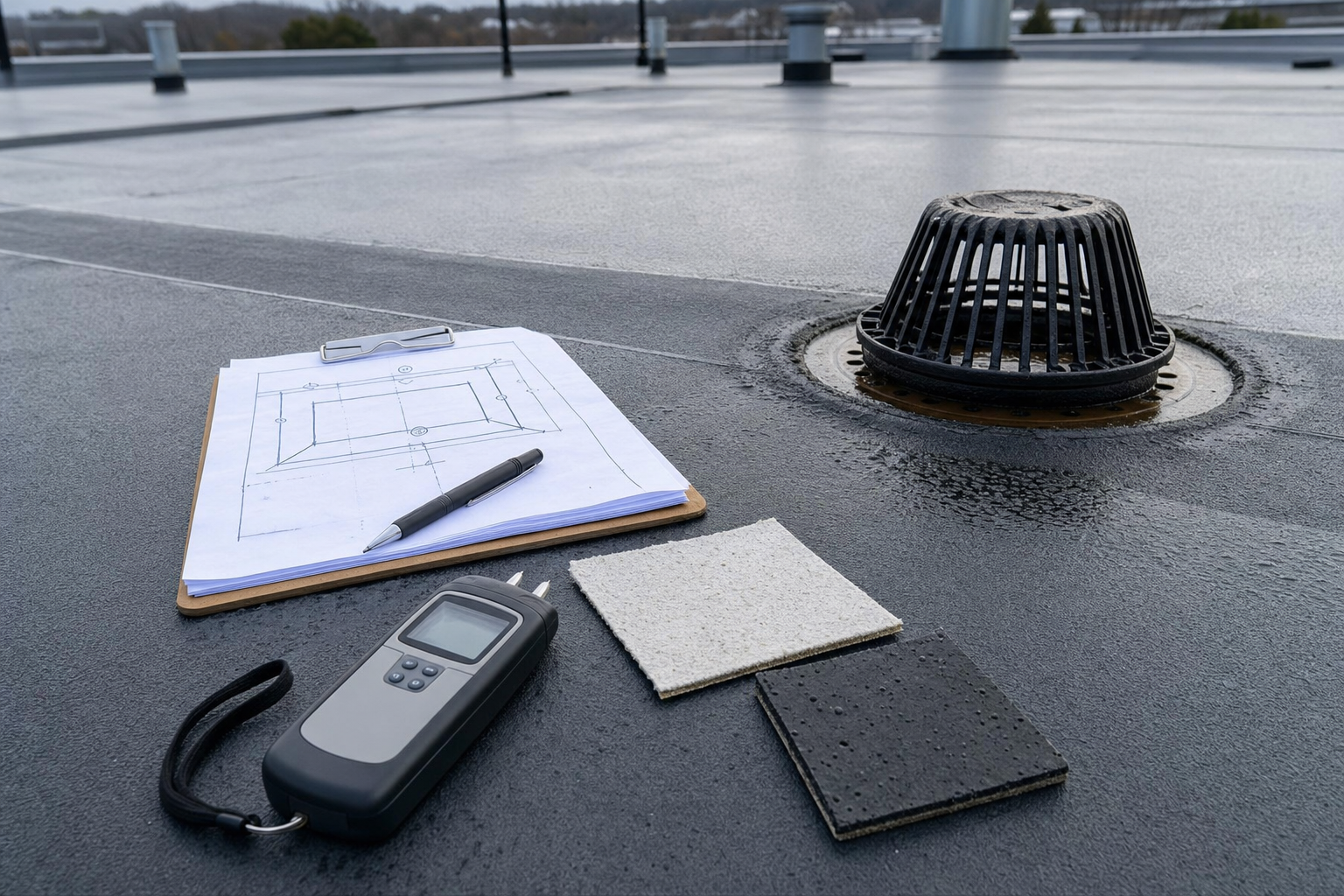
Schedule a commercial roof inspection in Lake County before choosing a membrane if the roof has leaks, ponding water, open seams, punctures, soft spots, repeated drainage problems, or visible storm damage. A flat roof inspection can also help before budgeting for replacement, comparing warranty options, or deciding whether TPO, EPDM, PVC roofing, modified bitumen, or another system fits the building.
A local inspection matters because commercial roofing Lake County IL decisions are shaped by Lake Michigan weather, freeze-thaw movement, rooftop equipment, drainage design, and the way each building is used. The inspection should document what is happening now, what can be repaired, and what should be planned before the next heavy rain, snow, or hail season.
FAQ
What is the biggest TPO vs EPDM commercial roof difference?
The biggest difference is how the membranes behave and how the seams are joined. TPO is a thermoplastic membrane with heat-welded seams, while EPDM is a synthetic rubber membrane usually joined with adhesive or seam tape.
Is TPO better than EPDM for commercial roofs?
Not automatically. TPO is often stronger for reflectivity and heat-welded seams, while EPDM is often valued for flexibility and long-term cold-weather performance. The roof design should decide.
Is TPO or EPDM better for Lake County commercial buildings?
Neither is automatically better. TPO may fit buildings that need reflectivity and welded seams, while EPDM may fit roofs that need flexibility, complex detailing, or budget control.
Does a white TPO roof always save more energy than black EPDM?
Not always. Reflectivity can help with summer heat, but insulation, roof assembly design, building use, and maintenance condition also affect performance.
Which commercial roof membrane handles winter better?
EPDM is often valued for cold-weather flexibility, but a properly designed TPO system can also perform well when drainage, insulation, seams, and installation quality are right.
Which lasts longer in Lake County and southern Wisconsin?
Service life depends on membrane thickness, installation quality, drainage, maintenance, rooftop traffic, storm exposure, and manufacturer system requirements. A well-installed EPDM roof can outperform a poorly installed TPO roof, and the reverse is also true.
Can a commercial flat roof be repaired instead of replaced?
Sometimes. Small punctures, open seams, flashing issues, or localized damage may be repairable. Saturated insulation, widespread seam failure, chronic ponding, or an aging system may point toward replacement.
When should a property manager schedule a flat roof inspection?
Schedule an inspection after leaks, ponding water, open seams, punctures, storm damage, repeated drainage problems, or before choosing a replacement membrane.
Closing CTA
If you manage a commercial building in Lake County, the North Shore, Kenosha County, or Racine County, Lake Point Exteriors can inspect your flat roof and explain whether TPO, EPDM, modified bitumen, PVC roofing, or another system fits the building. Document what you are seeing, then schedule a free commercial roof inspection with a local team that understands Lake Michigan weather.